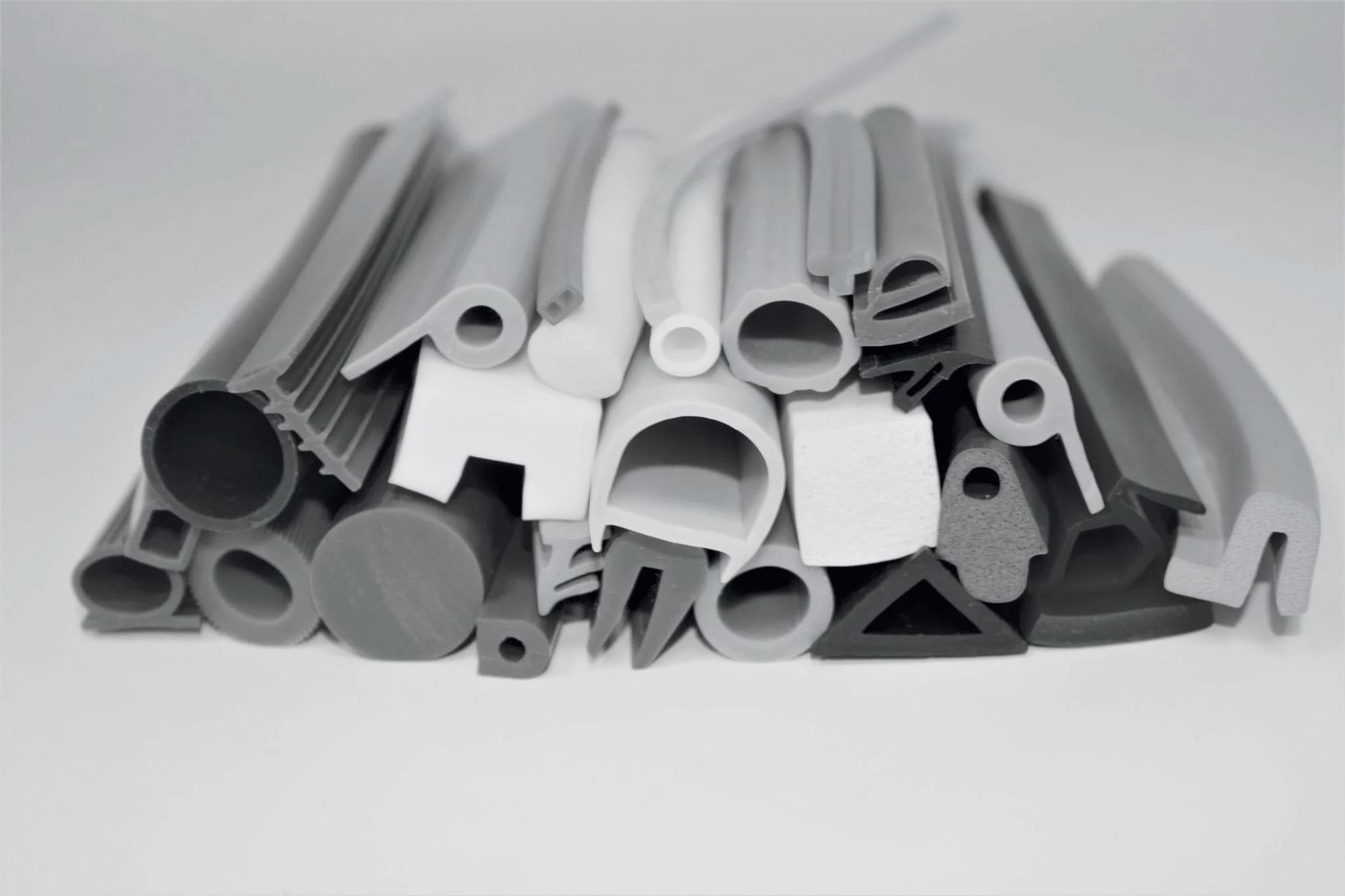
Silicone rubber is an elastomeric material derived from silicone, a polymer comprising silicon, carbon, hydrogen, and oxygen. The term "silicone" was first coined in 1901 by Kipping to describe compounds with the generic formula R₂SiO — soon identified as polymers, specifically polydialkylsiloxanes, where R may represent methyl, phenyl, vinyl, or trifluoropropyl groups.
In 1871, Ladenburg discovered that diethyldiethoxysilane (C₂H₅)₂Si(OC₂H₅)₂ produced an oil resistant to decomposition at high temperatures when exposed to a dilute acid. Kipping later advanced organosilicon chemistry by developing silanes via Grignard reactions and hydrolyzing chlorosilanes to form large molecules.
The most common silicones are polydimethylsiloxanes — trimethylsilyloxy-terminated polymers with the structure (SiMe₂O)ₙ, where "Me" represents a methyl group. These polymers are linear and liquid, even at large molecular weights. The main chain unit is often abbreviated as "D", with M, T, and Q units corresponding to other polymer configurations.
The unique properties of silicones arise from their dual nature: organic groups attached to an inorganic backbone. The Si–O bond energy is significantly higher than the C–C bond energy, imparting enhanced stability and resistance; silicones exhibit excellent thermal and thermo-oxidative resistance; and they resist electromagnetic and particle radiation (UV, alpha, beta, and gamma) far better than organic plastics.
General Properties of Silicone Rubber
Structure & stabilitySiloxane (Si–O) bonds offer higher binding energy (106.0 kcal/mol) than carbon bonds (84.9 kcal/mol), providing superior heat resistance, chemical stability, and electrical performance. The helical molecular structure and low intermolecular forces give high elasticity, compressibility, and cold resistance; outer methyl groups enable water repellency and good release properties.
Heat & cold resistanceMaintains properties at 150 °C for extended periods and tolerates up to 300 °C for short durations. Remains elastic down to −60 to −70 °C — organic rubbers turn brittle at −20 to −30 °C.
Weatherability & moistureHighly resistant to ozone, UV, wind and rain; absorbs minimal moisture (≈1%) and resists ordinary steam. High-pressure steam above 150 °C can reduce performance, mitigated by tailored formulations.
Tear, tensile & flex fatigueTear strengths of 9.8–49.0 kN/m with specialized grades for demanding applications. Advanced formulations offer up to 20× better flex fatigue resistance.
Compression setConsistent across a wide range (−60 to 250 °C), outperforming organic rubbers at elevated temperatures when properly cured.
Thermal conductivity & flame retardancyThermal conductivity of ≈0.2 W/(m·K), tunable with fillers. Resists ignition and can be made flame-retardant without toxic byproducts — suitable for electronics and confined spaces.
Electrical conductivityConductive grades, infused with carbon or silver, serve keyboards and high-voltage cable shielding. Stable insulation across temperatures and frequencies, with excellent resistance to corona discharge and arcing.
Chemical & oil resistanceResists high-temperature oils and polar organic compounds, with limited swelling in non-polar solvents like gasoline. Vulnerable to strong acids and bases.
Gas permeability & radiationHigh gas and vapour permeability enables use in oxygen enrichment systems. Methylphenyl silicone variants are effective in nuclear environments.
Physiological inertnessBiocompatible and free of plasticizers or latex — used in baby bottle nipples, stoppers, swimming caps, and goggles for its inertness and pleasant texture.
Applications of Silicone Rubber
AutomotiveGaskets, sealants, connectors, spark plugs, tyres, radiators, heat exchangers, and engine components like valve covers and oil pumps — thanks to heat, chemical and weather resistance, electrical insulation, and tear strength.
Aviation & aerospaceSealants for doors, windows and panels; fuel control diaphragms, hydraulic lines, cable clamps, and keypads for aerospace computers — stable under extreme temperatures and environmental stress.
Bakeware & cookwareBaking mats, moulds, cake pans, ice cube trays, utensils and spatulas — a flexible, non-stick surface that resists odours and transitions between freezer, oven, microwave, and dishwasher.
Semiconductors & toysEncapsulates semiconductors in industrial motors, power supplies, and high-temperature applications like aircraft engines and oil drilling; durable, weather-resistant and sterilizable for toys and play equipment.
Cable accessories & electronicsTerminations, insulators, and surge arrestors; seals and protects circuits, gaskets and components; heat-stable and kink-resistant for hoses and coolant lines.
Medical & veterinaryInert, free from plasticizers or latex — safe and reliable without harmful by-products.
MouldingFlexible, reusable moulds for industry, art and crafts — prototypes, small production runs, and reproductions in wax, plaster, concrete and resin, including archaeological findings, architectural elements, and museum artifacts.
References: [1] Amin M, Akbar M, Amin S (2007) Hydrophobicity of silicone rubber used for outdoor insulation. Rev Adv Mater Sci 16:10-26 · [2] Ghanbari-Siahkali A et al (2005) Investigation of the hydrothermal stability of cross-linked LSR. Polym Degrad Stab 90(3):471-480 · [3] Tan J, Li X, Zee JWV (2007) Degradation of silicone rubber under compression in a simulated PEM fuel cell environment. J Power Sources 172(2):782-789 · [4][5] Saleem A, Frormann L, Soever A (2010) Fabrication of extrinsically conductive silicone rubbers with high elasticity. Polymers 2:200 · [6] Hamdani S, Longuet C, Lopez-Cuesta JM, Ganachaud F (2009) Flame retardancy of silicone-based materials. Polym Degrad Stab 94(4):465-495.